Tom Holland Inspired Home Staging Tips to Transform Your Space
- Aug 30
- 8 min read
Updated: 4 days ago

A staged home should do more than look neat. It should help someone walk in, understand the room, and feel at ease within seconds. That is why Tom Holland’s style makes such a useful reference point. His public aesthetic often reads as relaxed, polished, youthful, and unforced. Think clean lines, casual tailoring, warm neutrals, and a sense of comfort that still feels camera-ready.
This post is not about copying a celebrity’s private home. It is about translating that understated, approachable energy into spaces that feel fresh, livable, and easy to imagine moving into. The same principles apply whether preparing a house for sale, refreshing a rental, or simply making a room work better.
Strong Home staging comes down to a few clear choices: color, layout, lighting, texture, and restraint. With the right training, those choices stop feeling like guesswork. That is where the Sumptuoza Home Staging Education courses can help, especially for homeowners, aspiring stagers, and design-minded creators who want to understand the “why” behind a beautiful room.

Start with a relaxed and polished color palette
Tom Holland’s style often works because it feels easy without looking careless. In interiors, that usually starts with a grounded color palette.
For staging, the goal is not to erase personality. The goal is to create a setting that lets buyers or guests picture themselves in the space. Warm neutrals are especially useful because they feel softer than stark white and more current than heavy beige.
A Tom Holland-inspired palette might include:
Warm white walls
Oatmeal or sand upholstery
Soft gray accents
Olive green, navy, or rust details
Natural wood tones
Matte black or aged brass finishes
These colors feel approachable, but they also photograph well. That matters if the home will be listed online, where the first showing often happens on a screen.
The trick is to keep the main surfaces calm and use deeper color in smaller doses. A navy pillow, a green throw, or a rust-toned vase can add character without taking over the room.
Practical tip
Choose one base color, one wood tone, and one accent color for each main room. Repeat them in small ways so the space feels connected. For example, a living room might use warm white walls, walnut furniture, and olive accents. A nearby dining area can echo the walnut and olive through chairs, art, or table decor.
Sumptuoza Home Staging Education courses cover this kind of visual decision-making in a structured way. Instead of relying only on taste, students learn how color influences mood, flow, and buyer perception.
Arrange furniture so the room feels natural to enter
A well-staged room should be easy to read. Someone should know where to sit, where to walk, and what the room is for. That sounds simple, but poor furniture arrangement is one of the most common reasons a space feels awkward.
Tom Holland’s style has a casual ease to it, and that same quality works beautifully in staging. Avoid stiff layouts where every piece is pushed against a wall. Focus on conversation, comfort, and proportion.
Start by identifying the room’s main purpose. In a living room, the anchor might be a sofa facing a fireplace, a pair of chairs, or a media wall. In a bedroom, the bed should usually be the first visual focus. In a dining room, the table needs enough space around it to feel usable.
Then edit the layout based on how people move.
A good staging arrangement should:
Leave clear walking paths
Make the room’s function obvious
Avoid blocking windows or natural light
Keep furniture proportional to the room
Create one strong focal point
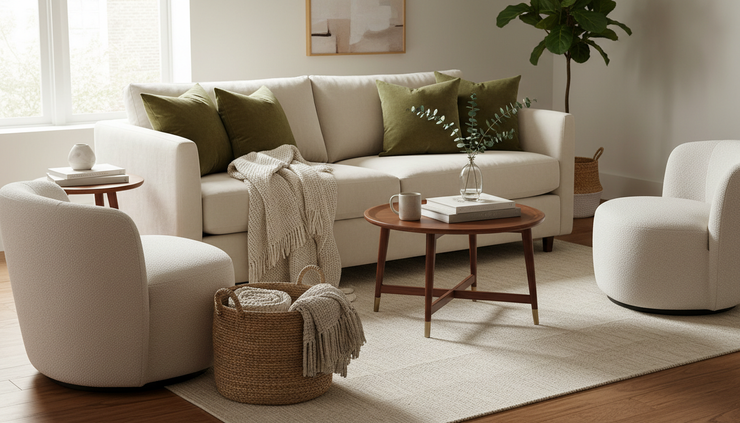
If a room is small, resist the urge to fill every corner. A compact sofa with open legs can make a living room feel lighter. A round dining table can soften a tight eating area. A bench at the foot of a bed can add style without crowding the space.
Practical tip
Stand in the doorway and take a photo of the room. The camera will show problems the eye often ignores, such as a sofa that feels too bulky, a chair that blocks flow, or a coffee table that sits too far away from the seating.
This is one reason professional training matters. In the Sumptuoza Home Staging Education courses, learners study room function, visual balance, and placement choices that improve both in-person showings and listing photos.
Use lighting to create atmosphere and clarity
Lighting can make a room feel expensive, clean, cozy, or flat. It is one of the fastest ways to change the mood of a space.
A Tom Holland-inspired room should feel warm and inviting, not overly dramatic. Think soft evening light, a comfortable reading corner, or a casual dinner with friends. For staging, that means layering light instead of relying on one ceiling fixture.
Most rooms need three kinds of lighting:
Ambient light
Task light
Accent light
General light from ceiling fixtures, recessed lights, or natural daylight
Focused light from reading lamps, kitchen pendants, or bathroom vanity lights
Softer light that highlights art, shelves, plants, or architectural details
The right combination creates depth. A living room with only overhead lighting can feel harsh. Add a floor lamp near a chair and a table lamp beside the sofa, and the room starts to feel finished.
Warm bulbs usually work best in living rooms and bedrooms. In kitchens and bathrooms, clean white light can help the space feel fresh, but it should not feel cold or blue.
Practical tip
Before photos or showings, turn on every lamp, open curtains, and replace mismatched bulbs. If one lamp glows yellow and another looks blue, the room can feel disjointed. Consistent bulb temperature makes the whole space feel more professional.
Lighting is also a skill that improves with practice. A strong Home staging course teaches how light affects color, texture, and photography. Sumptuoza’s training helps students understand these details so their rooms look good in real life and on camera.
Add personality through texture instead of clutter
A home can feel styled without looking busy. That balance is central to effective staging.
Tom Holland’s style often feels youthful and low-key, so the interiors inspired by that mood should not feel overdecorated. Skip heavy displays and choose touchable textures instead. Texture gives a room warmth while keeping the palette simple.
Use materials such as:
Linen
Boucle
Cotton
Wool
Light leather
Woven fibers
Ceramic
Natural wood
A cream sofa with a chunky knit throw, a smooth wood table, and a matte ceramic vase can feel more interesting than a room filled with small decorative objects. The eye gets variety without distraction.
The key is to aim for lived-in, not messy. A staged room should suggest comfort, but it should not show too much personal history. Family photos, personal paperwork, crowded shelves, and niche collections can make it harder for someone else to imagine the home as theirs.

Practical tip
Edit accessories in rounds. Remove half of the small items from a shelf, then step back. Keep pieces that support the room’s color story or purpose. If an item does not add shape, warmth, scale, or meaning, store it away during staging.
Sumptuoza Home Staging Education courses help learners practice this editing process. That matters because staging is not just decorating. It is making intentional choices that serve a goal.
Let each room tell one clear story
Every staged room should answer a quiet question: “What can I do here?”
A spare room with a random dresser, treadmill, and boxes tells a confusing story. A spare room staged as a compact guest room or calm reading space tells a clear one. Buyers and guests respond better when the purpose feels obvious.
A Tom Holland-inspired approach might lean into ease and function. Instead of creating rooms that look untouchable, create spaces that feel usable right away.
For example:
A small bedroom
An awkward corner
A basement area
A dining nook
Stage it as a guest room with a simple bed, warm lamp, and one piece of art
Turn it into a reading nook with a chair, side table, and floor lamp
Define it as a casual media space with low seating and layered lighting
Keep it simple with a clean table, two to four chairs, and one centerpiece
The story should fit the size of the room. Do not force a home gym into a space that barely fits a yoga mat. Do not turn a formal dining room into a storage zone during showings. Each area should feel intentional.
Practical tip
Write a three-word purpose for each room before staging it. Examples include “calm primary bedroom,” “casual movie lounge,” or “bright breakfast corner.” If a furniture piece or accessory does not support those three words, reconsider it.
Professional stagers use this kind of clarity all the time. The Sumptuoza Home Staging Education courses teach students how to plan room stories and apply them consistently across a whole property.
Make small updates that look high impact
Staging does not always require major renovation. Many of the most effective updates are simple, affordable, and fast.
That fits the Tom Holland-inspired mood well. The look is not flashy. It is considered, clean, and comfortable. Small improvements can create that impression when they are done with care.
Focus on updates that improve the first impression:
Replace tired throw pillows with simple textured covers
Swap heavy curtains for lighter panels
Add a large mirror to bounce light
Use matching hangers in visible closets
Upgrade cabinet hardware if it looks dated
Add fresh white towels in bathrooms
Use one simple arrangement on a dining table
Clear kitchen counters except for a few useful pieces
Kitchens and bathrooms deserve special attention because people inspect them closely. Clean surfaces, good lighting, and minimal clutter matter more than elaborate styling.
A bathroom can feel fresher with a clean shower curtain, folded towels, a small stool, and one plant. A kitchen can feel more inviting with a wood cutting board, a bowl of lemons, and clear counters.

Practical tip
Spend money where the eye lands first. In a bedroom, that may be bedding. In a living room, it may be the rug or sofa pillows. In an entryway, it may be lighting, a mirror, or a clean console table.
Training helps homeowners and future professionals decide which updates matter most. Sumptuoza Home Staging Education courses can help students avoid common mistakes, such as spending too much on decor while ignoring layout, light, or scale.
Know when professional training changes the result
Some staging choices feel intuitive. Others require a trained eye.
A homeowner can declutter, clean, and rearrange furniture with strong results. But professional-level staging asks for more. It involves buyer psychology, photo readiness, spatial planning, color theory, inventory selection, and the ability to make a room appealing without making it feel generic.
That is why education can make such a difference. A structured program helps learners understand repeatable principles instead of guessing room by room.
Professional training can help with:
Reading a room’s strengths and weaknesses
Choosing colors that photograph well
Understanding scale and proportion
Creating flow through furniture placement
Styling shelves, beds, tables, and entryways
Preparing spaces for listing photos
Communicating staging recommendations clearly
For anyone who wants to stage their own home, build confidence, or start offering services, the Sumptuoza Home Staging Education courses offer a focused path to learn these skills with more intention.
The most valuable part is not learning one fixed style. It is learning how to adapt. A city condo, a suburban family home, a vacation property, and a compact studio all need different choices. The principles stay the same, but the execution changes.
Bring the Tom Holland-inspired look together
A Tom Holland-inspired staged space should feel warm, composed, and comfortable. It should have personality, but not so much that the room becomes about the owner. It should look current, but not trendy in a way that will feel dated too quickly.
Use this quick checklist when styling a room:
Keep the base palette warm and neutral
Add one or two grounded accent colors
Arrange furniture for easy movement
Create one clear focal point
Use lamps to soften the room
Add texture through textiles and natural materials
Edit personal items and visual clutter
Make the room’s purpose clear
Photograph the space to check balance
If the room feels calm, useful, and inviting from the doorway, the staging is doing its job.
For a more complete understanding of these techniques, explore the Sumptuoza Home Staging Education courses. The right training can turn instinct into skill and help you create spaces that look polished, welcoming, and ready for their next chapter.
A well-staged home does not need to shout for attention. Like the best relaxed style, it works because every choice feels natural. Start with comfort, edit with care, and let each room make a clear, confident first impression.


